
If you’ve ever asked how many cubic feet in a yard, you’re dealing with a very common question in construction, landscaping, and everyday measurements.
At first glance, it might seem confusing—but once you understand how cubic units work, the answer becomes simple and easy to remember.
This guide will walk you through everything you need to know, including formulas, examples, and practical uses.
Quick Answer: Yard to Cubic Feet
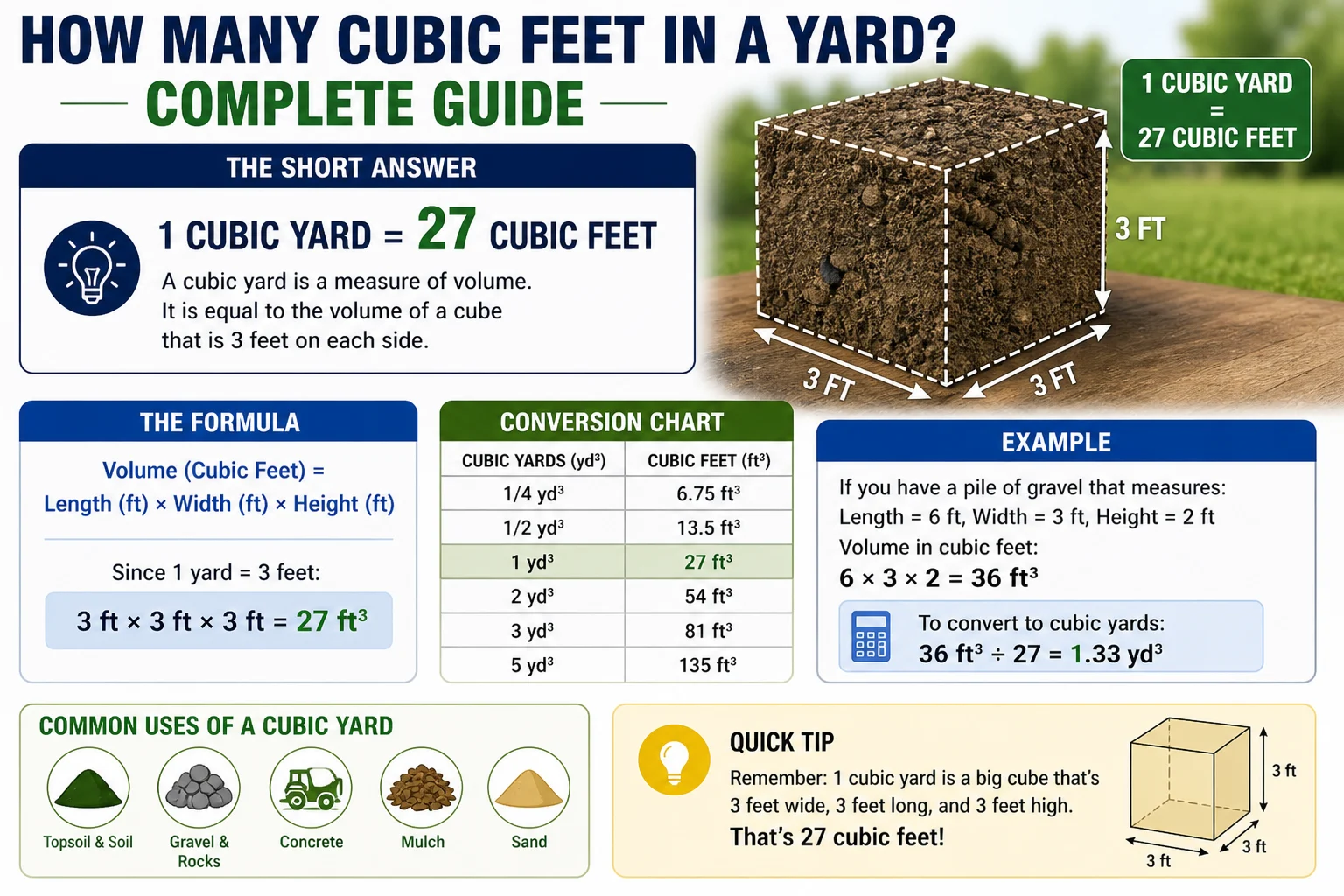
👉 1 cubic yard = 27 cubic feet
This is a fixed and exact conversion used everywhere.
What Is a Cubic Yard?
Definition
A cubic yard is a unit of volume. It measures space in three dimensions.
It represents a cube that is:
- 1 yard long
- 1 yard wide
- 1 yard high
Real-World Usage
Cubic yards are commonly used for:
- Concrete
- Soil
- Sand
- Gravel
Understanding Cubic Feet
A cubic foot is also a unit of volume.
It represents a cube that is:
- 1 foot long
- 1 foot wide
- 1 foot high
Why 27 Cubic Feet? (Step-by-Step)
Let’s break it down simply.
We know:
- 1 yard = 3 feet
Now convert each dimension:
- Length = 3 ft
- Width = 3 ft
- Height = 3 ft
Now multiply:
3 × 3 × 3 = 27
👉 That’s why 1 cubic yard = 27 cubic feet
Cubic Yard to Cubic Feet Formula
Here’s the simple formula:
Cubic Feet=Cubic Yards×27
Conversion Table
Here’s a quick reference:
| Cubic Yards | Cubic Feet |
|---|---|
| 1 | 27 |
| 2 | 54 |
| 3 | 81 |
| 5 | 135 |
| 10 | 270 |
Real-Life Examples
Let’s make it practical.
Concrete for a Project
If you need 2 cubic yards:
👉 2 × 27 = 54 cubic feet
Garden Soil
1 cubic yard of soil:
👉 Covers 27 cubic feet of space
Gravel for Driveway
3 cubic yards:
👉 Equals 81 cubic feet
What Does a Cubic Yard Look Like
Visualizing helps a lot.
Imagine a box that is:
- 3 feet long
- 3 feet wide
- 3 feet high
That box equals 1 cubic yard.
Why This Conversion Matters
Knowing how many cubic feet in a yard is useful for:
Construction
- Ordering materials
- Avoiding waste
Landscaping
- Soil and mulch estimation
DIY Projects
- Filling spaces
- Planning storage
Common Mistakes
Confusing Square Feet with Cubic Feet
- Square = area
- Cubic = volume
Forgetting to Multiply All Dimensions
It’s not just 3—it’s 3 × 3 × 3
Using Wrong Units
Always confirm you’re working in cubic units.
Tips for Accurate Volume Calculation
Measure Carefully
Get accurate dimensions.
Use Consistent Units
Convert everything to feet first.
Double-Check Results
Avoid costly mistakes.
Practice Examples
Try these:
Example 1
Convert 4 cubic yards
👉 4 × 27 = 108 cubic feet
Example 2
Convert 6 cubic yards
👉 6 × 27 = 162 cubic feet
Example 3
Convert 8 cubic yards
👉 8 × 27 = 216 cubic feet
Real-Life Scenario
Let’s say you’re filling a box:
- Length = 9 ft
- Width = 3 ft
- Height = 1 ft
Volume = 27 cubic feet
👉 That equals 1 cubic yard
9. FAQs
1. How many cubic feet in a yard exactly?
There are 27 cubic feet in one cubic yard.
2. Why is it 27 cubic feet?
Because 1 yard equals 3 feet, and 3 × 3 × 3 = 27.
3. Is this conversion always the same?
Yes, it’s a fixed measurement.
4. How do I convert yards to cubic feet?
Multiply by 27.
5. What is a cubic yard used for?
It’s used for measuring materials like soil, concrete, and gravel.
10. Conclusion
So, how many cubic feet in a yard?
👉 1 cubic yard = 27 cubic feet
This simple conversion is essential for construction, landscaping, and everyday calculations.
By understanding the formula and practicing a few examples, you can easily calculate volume without confusion.
Remember the key rule:
👉 Multiply by 27
Once you know this, working with volume becomes quick, easy, and accurate.
Discover More Articles
How Many Feet Is 59 Inches? Complete Guide