

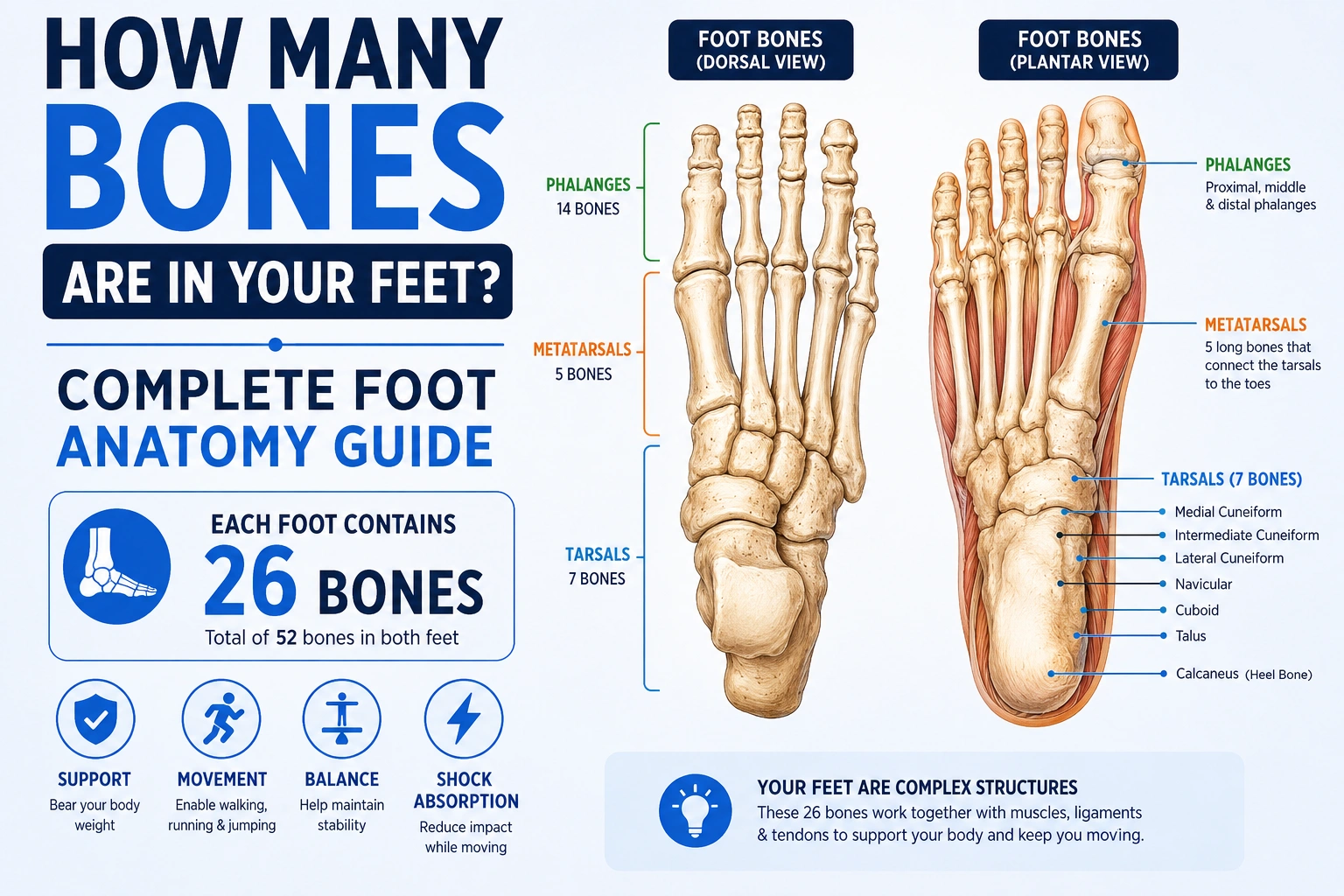
The human foot is one of the most complex structures in the body. It supports your weight, helps maintain balance, absorbs shock, and enables movement during walking, running, and jumping. Despite their relatively small size, your feet contain a surprisingly large number of bones.
Together, both feet contain more than a quarter of all the bones in the human body.
Quick Answer
The average adult has:
- 26 bones in each foot
- 52 bones in both feet combined
Since the adult human skeleton contains 206 bones, the feet account for approximately 25% of all bones in the body.
How Many Bones Are in One Foot?
Each foot contains:
- 26 bones
- 33 joints
- More than 100 muscles, tendons, and ligaments
Bone distribution:
| Foot Region | Number of Bones |
|---|---|
| Tarsals | 7 |
| Metatarsals | 5 |
| Phalanges (Toes) | 14 |
| Total | 26 |
This structure provides strength, flexibility, and stability.
The Three Main Groups of Foot Bones
Tarsal Bones
The tarsals form the rear and middle portions of the foot.
There are 7 tarsal bones:
- Talus
- Calcaneus (heel bone)
- Navicular
- Cuboid
- Medial cuneiform
- Intermediate cuneiform
- Lateral cuneiform
These bones help support body weight and facilitate movement.
Metatarsal Bones
The middle section of the foot contains:
- 5 metatarsal bones
These long bones connect the tarsals to the toes and help distribute weight during walking and running.
Phalanges (Toe Bones)
The toes contain:
- 14 phalanges
Breakdown:
- Big toe: 2 bones
- Other four toes: 3 bones each
Total:
- 14 toe bones
Why Do Feet Have So Many Bones?
The foot must perform several demanding functions.
These include:
- Supporting body weight
- Maintaining balance
- Absorbing impact
- Adapting to uneven surfaces
- Providing propulsion during walking and running
The large number of bones allows the foot to remain both strong and flexible.
Functions of Foot Bones
Support
Foot bones create the foundation that supports the body’s weight.
Balance
The structure of the foot helps maintain stability while standing and moving.
Shock Absorption
Foot bones and joints help absorb forces generated during walking and running.
Movement
The bones work with muscles and tendons to produce efficient motion.
Interesting Facts About Foot Anatomy
- Each foot contains 26 bones.
- Both feet contain 52 bones combined.
- More than one-quarter of the body’s bones are located in the feet.
- The heel bone (calcaneus) is the largest foot bone.
- The foot contains 33 joints.
- Human feet are designed to support several times body weight during activities such as running.
Bone Count Comparison
| Body Part | Number of Bones |
|---|---|
| One Foot | 26 |
| Both Feet | 52 |
| One Hand | 27 |
| Both Hands | 54 |
| Entire Human Skeleton | 206 |
This comparison highlights the complexity of the feet.
FAQs
1. How many bones are in your feet?
Both feet contain a total of 52 bones.
2. How many bones are in one foot?
Each foot contains 26 bones.
3. What percentage of the body’s bones are in the feet?
Approximately 25% of the body’s bones are located in the feet.
4. Which foot bone is the largest?
The calcaneus, or heel bone, is the largest bone in the foot.
5. How many toe bones are there?
There are 14 toe bones, known as phalanges, in each foot.
Conclusion
Human feet contain an impressive 52 bones in total, with 26 bones in each foot. These bones are divided into the tarsals, metatarsals, and phalanges, creating a highly specialized structure capable of supporting body weight, maintaining balance, absorbing shock, and enabling movement. With more than one-quarter of the body’s bones located in the feet, they are among the most complex and important parts of the human skeletal system.
Discover More Articles
How Many Feet Is 26 Inches? Exact Conversion Guide
How Many Square Feet Is Considered a Mansion? Luxury Home Size Guide
How Many Square Feet Is 5 Acres? Exact Land Size Conversion Guide